Site Record
Metadata
Site Name |
Paisley 5-Mile Point Cave 1 and 2 |
Site# |
35LK3400 |
Map |
Click here to view map. Click here to view map. |
Description |
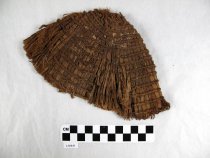
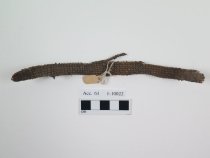
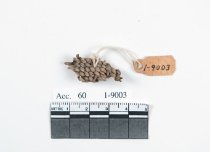
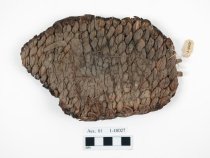
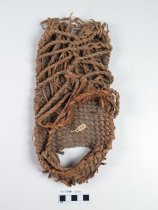
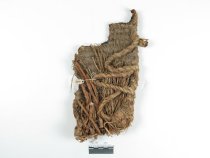
Paisley Five-Mile Point Caves (Accessions 60, 61, 100BP, 1294, 1374, 1896, 1961) (35LK3400) The Paisley Caves (35LK3400) are located on a rock ridge-Five Mile Point-near the southeast edge of the Summer Lake Basin, north of the town of Paisley in Lake County, south-central Oregon. The site includes eight wave-cut cavities cut into the ridge by a high stand of pluvial Lake Chewaucan.Walter J. Perry, a frequent correspondent with Luther Cressman, was alerted to the site by a local woman who had been digging in the caves for artifacts. Perry dug a pit in the center of Paisley Cave #1 in 1937, and reported his visit in a letter to Luther Cressman: I returned and spent a day trying to certainly verify human habitation below what I am convinced is a stratum of water borne material in the cave. There is much ash, charcoal, etc., below it, and the last trip I found a "mano" on a hearth just below the clean white pumice. In the second cave, Perry reported digging through about 30 inches of camp refuse. Within this he found (Accession 100BP): Several pieces of twisted tule cord, fragments of heavy matting, a fragment of open work basketry, fragment of leather, and a large sandal (at 20") woven from tule and with peculiar binding arrangement. Also many cracked bones, and obsidian chips were found throughout. Bottom not reached. Perry led Cressman, and geologist Ernst Antevs, to the Paisley Caves later that summer. They immediately recognized the significance of cultural artifacts below pumice from the Mt. Mazama eruption (Cressman 1988). The following year, Cressman's primary objective was the excavation of Roaring Springs Cave, which took place between June 26 and July 10, but this was preceded by a short trip to Catlow Cave (June 23-25) and followed by investigations at Paisley (July 11-16) and Fort Rock (July 18-26) caves (Accession 60). Cressman's crew dug exploratory trenches in Paisley Caves 1, 2, and 3 during the 1938 trip. The excavation was quick and rough, and only artifacts and faunal remains found in situ were recorded with precise vertical and horizontal provenience. In Cave 3 the excavators found a floor, well below the Mazama tephra, that had apparently been cleared of stones and outlined with boulders. Obsidian artifacts were recovered from the living floor and surrounding area, and the bones of late Pleistocene camel, bison, and horse (some charred) appeared to have been tossed around the edge of clear zone. Cressman believed that the bones of now-extinct Pleistocene animals represented food remains left by the cave's occupants (Cressman 1942:93). Cressman returned to the site in 1939, and removed the majority of deposits from the main chambers of these caves (Accession 61). He briefly returned a third time in 1940 to broaden the excavated area in Cave 3 where he believed the evidence for a Pleistocene-age occupation was present (Cressman 1940). Cressman recovered Multiple Warp type sandals, Catlow Twine basketry, twined matting, and wood artifacts above the pumice; a fragment of sagebrush bark matting and rope, and a strand of 2-ply tule cord were found below pumice. Not all of Cressman's colleagues were convinced that the association of cultural materials with extinct Pleistocene fauna had been clearly demonstrated (Krieger 1944; Heizer and Baumhoff 1970:5; Jennings 1986). In an attempt to resolve this issue, Dennis Jenkins returned to the Paisley Caves intermittently between 2002 and 2017 with University of Oregon field schools, supported by the Bureau of Land Management (Accessions 1294, 1374, 1896, 1961). Jenkins' examined caves 1 through 5. They found that remains of Pleistocene megafauna and cultural materials were associated in the caves, and that human coprolites and extinct megafauna were both present by 14,500 years ago, making the site one of the oldest firmly dated occurrences of human presence in North America (Gilbert et al. 2008; Jenkins et al. 2012, 2013, 2016). Sources: Cressman, Luther S. 1942 Archaeological Researches in the Northern Great Basin. Carnegie Institution of Washington, Publication, 538. 1986 Prehistory of the Northern Area. In Great Basin: Handbook of North American Indians, Volume 11, edited by Warren L. d'Azevedo, pp. 120-126. Smithsonian Institution, Washington, D.C. Cressman, Luther S. and Howel Williams 1940 Early Man in Southcentral Oregon: Evidence from Stratified Sites. In Early Man in Oregon: Archeological Studies in the Northern Great Basin, by Luther S. Cressman, Howel Williams, and Alex D. Krieger, pp. 53-77. University of Oregon Monographs, Studies in Anthropology No 3, Eugene. Gilbert, M. Thomas P., Dennis L. Jenkins, Anders Götherstrom, Nuria Naveran, Juan J. Sanchez, Michael Hofreiter, Philip Francis Thomsen, Jonas Binladen, Thomas F. G. Higham, Robert M. Yohe II, Robert Parr, Linda Scott Cummings, Eske Willerslev 2008 DNA from Pre-Clovis Human Coprolites in Oregon, North America. Science 320:786-789. Heizer, Robert F. and Martin A. Baumhoff 1970 Big Game Hunters of the Western Great Basin: A Critical Review of the Evidence. In Papers on the Anthropology of the Western Great Basin. University of California Archaeological Research Facility 7:1-12. Jenkins, Dennis L., Loren G. Davis, Thomas W. Stafford, Jr., Thomas J. Connolly, Michael Rondeau, Linda Scott Cummings, Bryan Hockett, Katelyn McDonough, Ian Luthe, Patrick W. O'Grady, Karl J. Reinhard, Mark E. Swisher, Frances White, Robert M. Yohe II, Chad Yost, and Eske Willerslev 2016 Younger Dryas Archaeology and Human Experience at the Paisley Caves in the Northern Great Basin. In Stones, Bones, and Profiles: Archaeology and Geoarchaeology in Honor of C.V. Haynes, Jr. and George C. Frison, edited by Marcel Kornfeld, Bruce B. Huckell, pp.127-205. The University Press of Colorado, Boulder. Jenkins, Dennis L., Loren G. Davis, Thomas W. Stafford, Jr., Paula F. Campos, Thomas J. Connolly, Linda S. Cummings, Michael Hofreiter, Bryan Hockett, Katelyn McDonough, Ian Luthe, Patrick W. O,Grady, Karl J. Reinhard, Mark E. Swisher, Frances White, Bonnie Yates, Robert M. Yohe II, Chad Yost, and Eske Willerslev 2013 Geochronology, Archaeological Context, and DNA at the Paisley Caves. In Paleoamerican Odyssey, edited by Kelly E. Graf, Caroline V. Ketron, and Michael R. Waters, pp. 485-510. Center for the Study of First Americans, College Station, Texas. Jenkins, Dennis L., Loren G. Davis, Thomas W. Stafford, Jr., Paula F. Campos, Bryan Hockett, George T. Jones, Linda Scott Cummings, Chad Yost, Thomas J. Connolly, Robert M. Yohe II, Summer C. Gibbons, Maanasa Raghavan, Morten Rasmussen, Johanna L. A. Paijmans, Michael Hofreiter, Brian M. Kemp, Jodi Lynn Barta, Cara Monroe, M. Thomas P. Gilbert, and Eske Willerslev 2012 Clovis Age Western Stemmed Projectile Points and Human Coprolites at the Paisley Caves . Science 337:223-228. Jennings, Jesse D. 1986 Prehistory: Introduction. In Great Basin: Handbook of North American Indians, Volume 11, edited by W. L. d'Azevedo, pp. 113-119. Smithsonian Institution, Washington, D.C. Krieger, Alex D. 1944 Review of "Archaeological Researches in the Northern Great Basin" by L. S. Cressman, F. C. Baker, P. S. Conger, H. P. Hansen, and R. F. Heizer. American Antiquity 9(3):351-359. |