Site Record
Metadata
Site Name |
Roaring Springs Cave |
Site# |
35HA433 |
Map |
Click here to view map. Click here to view map. |
Description |
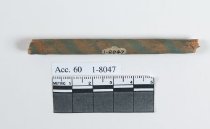
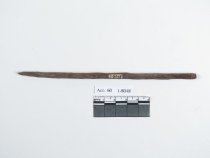
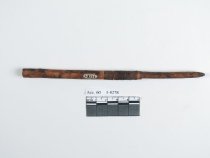
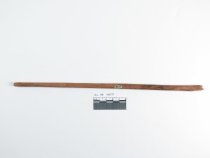
ROARING SPRINGS CAVE (Accessions 56, 60) (aka Catlow Cave No. 2, 35HA433) Roaring Springs Cave (35HA433) is located at the base of Catlow Rim, about 30 miles north of Catlow Cave, in Harney County, Oregon. The site actually consists of two associated shelters, identified in notes and other references as Roaring Springs Caves 1 and 2, or Catlow Caves 2 and 3. Springs flow to the north and south of the cave. These have been channeled for agriculture, but at one time fed a large marsh in the valley below the cave; Cressman (1942:21) noted that "These springs are perennial, and the volume of water is such that in previous years, before canals and dikes were constructed . . . the water flowed for several kilometers across the valley floor." Roaring Springs Cave was first visited by Cressman, Howard Stafford, and Fred Voget on July 10, 1935, while en route to their summer field camp at Catlow Cave. After the close of excavations at Catlow Cave in 1937, Cressman again took his crew to Roaring Springs where they dug an exploratory pit at the mouth of the cave. Cressman's (1937) field notes describe the discovery of a cache pit lined with tule and grass matting, and containing the fragments of at least two large baskets (Accession 56). The main excavation of the cave took place from June 26 to July 10, 1938 (Accession 60). The cave was divided into two meter squares, and fill was passed through one-half inch mesh screens. Three strata were distinguished in the fill, the first being a disturbed layer of dust, vegetation and horse manure five to 15 cm thick, the second being a homogenous layer of dust and matted vegetation averaging a meter in depth, and the third a layer of fragmented rock and debris at the floor of the cave. Cressman's crew dug in two meter squares, with levels "approximately 20 or 30 cm in depth" (Cressman 1938). Horizontal levels were dug into a sloping floor, making "the rear of each square deeper than the front," and likely cross-cutting and mixing natural strata. In his later analysis of Cressman's collection, Wilde (1985: 219) notes that fewer than 12% of collected artifacts from Roaring Springs Cave were located in situ and assigned Cartesian locations. All other artifacts were recovered from arbitrary excavation levels of variable thickness, a procedure that "resulted in additional blurring of the record already disturbed by rodents and overlapping occupations." Wilde classified 403 projectile points with known provenience from Roaring Springs Cave in an attempt to relatively date each collection units. His results confirmed that the deposits were mixed, "either through bioturbation or as a result of the excavation and collection methods" (Wilde 1985: 234). Based on the overall point assemblage, however, he concluded that the most extensive cave occupations were during the early Holocene, and again during the last ca. 2800 years. With the exception of a single date thought to be unreliable, some 30 radiocarbon dates subsequently run on fiber artifacts from the site all fall within the last ca. 4500 years (Connolly 2013; Connolly et al. 1998; Connolly et al. 2016). Fiber artifacts occur throughout the cultural deposits at Roaring Springs Cave. Multiple Warp and Spiral Weft sandals were recovered, but no Fort Rock-style sandals, which are exclusive to the early Holocene. Four fragments of coiled basketry and fragments of three leather moccasins were also recovered from near-surface contexts, which Cressman (1942: 57) considered to be "intrusive in the area at a date after the cave had been abandoned by its earlier occupants." Later radiocarbon dating places the earliest Roaring Springs coiled basketry at about 2550 years old (Connolly 2013). Roaring Springs Cave has provided the finest collection of basketry recovered to date from eastern Oregon cave sites, in terms of quantity, quality of workmanship and variety (but no basketry from the site dates older than ca. 4500 years). Because of this, Cressman (1942: 34) based the bulk of his discussion of Oregon's prehistoric basketry tradition on the assemblage from this site: "Since Roaring Springs Cave furnished the most numerous series as well as the finest twined ware, I shall use that product as the basis of the discussion. The other caves will be referred to as they provide some distinctive variation from this type ware." The Roaring Springs Cave basketry includes a number of especially outstanding decorated pieces. Indeed, while undecorated basketry is numerically most significant in the Catlow Cave assemblage (61% to 39%), decorated basketry outnumbers undecorated fragments at Roaring Springs (34% to 66%). Taking basketry from both sites together, 85% of the decorated specimens were embellished with overlay elements, while the remaining 15% was decorated with false embroidery. Overlay is accomplished by simply placing a decorative fiber over a structural fiber, and twining them together, so that the orientation of the overlay fiber parallels the structural fiber it covers, and is woven around the warp in the same manner as the structural weft fiber. False embroidery refers to the wrapping of the exterior fiber of the weft pair with a decorative element. Its orientation, therefore, is at right angles to the structural fiber it covers. Because it is wrapped around the exterior element of the weft pair, it cannot be seen on the interior of the basket as the overlay element can. Sources: Connolly, Thomas J. 2013 Implications of New Radiocarbon Ages on Coiled Basketry from the Northern Great Basin. American Antiquity 78(2):373-384. Connolly, Thomas J., Pat Barker, Catherine S. Fowler, Eugene M. Hattori, Dennis L. Jenkins, and William J. Cannon 2016 Getting Beyond the Point: Textiles of the Terminal Pleistocene/Early Holocene in the Northwestern Great Basin. American Antiquity 81(3):490-514. Connolly, Thomas J., Catherine S. Fowler, and William J. Cannon 1998 Radiocarbon Evidence Relating to Northern Great Basin Basketry Chronology. Journal of California and Great Basin Anthropology 20(1):88-100. Cressman, Luther S. 1937 Fieldnotes. On file at the Oregon State Museum of Anthropology, University of Oregon, Eugene. 1938 Fieldnotes. On file at the Oregon State Museum of Anthropology, University of Oregon, Eugene 1942 Archaeological Researches in the Northern Great Basin. Carnegie Institution of Washington Publication 538, Washington D.C. Wilde, James D. 1985 Prehistoric Settlements in the Northern Great Basin: Excavations and Collections Analysis in the Steens Mountain Area, Southeastern Oregon. Ph.D. Dissertation, Department of Anthropology, University of Oregon. |